
Building long-term trust
You’ll find it difficult to ride out the disruptions caused by the ceaseless turbulences of our times if you don’t strengthen your organization’s trust capital. Sucher and Gupta suggest (re)building and developing an enduring “trust pact” with your teams and customers in four stages.
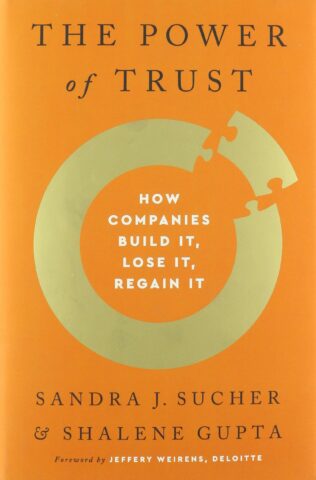
The Power of Trust : How Companies Build It, Lose It, Regain It,
by Sandra J. Sucher and Shalene Gupta, (Public Affairs, 2021).
Your organization’s trust capital is the foundation on which the loyalty of your teams and fidelity of your customers is based, and it guarantees the sustainability of your business. However, in times of economic and financial crisis (such as 1987, 2008 and 2020), the trust we have in companies drops. And this is especially the case today: The health crisis hasn’t just shaken up the supply and demand mechanisms; it has also called our business models and work organization into question.
Building trust in your organization takes place in four stages:
Capitalize on expertise: At a time when the health crisis has disrupted working methods and distribution channels, you have to innovate (you don’t have the choice!) in order to offer reliable solutions to meet new needs.
Boost buy-in: (Re)define your organization’s purpose so you can adapt it to post-pandemic social issues.
Ensure fairness: When times are tough, don’t forget to treat all your stakeholders – and especially your employees – fairly, no matter where they are based.
Demonstrate impact: Be sure todemonstrate the alignment between your organization’s purpose and its real impact by measuring the latter and correcting it, if necessary.
No. 1: Expertise: The foundation of all trust
Expertise – your teams’ ability, in other words, to design and supply products or services that your customers can’t do without – is the bedrock of your organization’s trust capital. It creates a fundamental but limited cognitive trust based on the rational assessment of objective qualities attached to a brand (relevance, reliability and efficiency) because of the excellence of its methods and/or its technical and human know-how.
The teams working at Uber are constantly innovating to improve procedures and services. The firm is seen as the company most able to rapidly transport users from A to B. This core competence has never been found wanting, which explains the platform’s resilience in spite of criticism (such as the viral #DeleteUber campaign, which saw it lose over 200,000 users in 2017). Although cognitive trust in Uber is very high, the affective trust it inspires in people is very low (rooted in a deeper, longer-lasting emotional experience1). This means that the company has an appalling reputation when it comes to social issues: You trust it to take you where you want to go – but you wouldn’t entrust your children to it!
The pattern is similar with Amazon. The paralysis of physical distribution networks during lockdowns confirmed that the digital model employed by Jeff Bezos’ firm is highly relevant and effective. Amazon’s turnover jumped 38 percent in 2020, while its net profit tripled in the first quarter of 2021. Although Amazon has become a firm we just can’t do without, it is still under attack for its human-resources management and tax strategy, which weakens its position.
Cognitive trust is the sine qua non for initiating trust, but not for maintaining it over time: Trust needs to be fueled by genuine buy-in.
No. 2: Purpose: Boosting buy-in
To win the lasting support of your customers and stakeholders (employees, suppliers, investors, governments and society), you have to draw up a mission statement that is identified as being altruistic, i.e., geared towards the good of the community. Studies in the field of psychology have shown that cooperation is one of the most instinctive human reactions2: Groups have a desire to punish individuals or organizations that knowingly obstruct collective exchanges.3 Researchers have also shown that an unintentional wrong is more easily forgiven than an intentional wrong, even if the end result is exactly the same.4 And the reverse is also true: Intentional harm is always judged more severely, even if its consequences are minimal.5 So, if you want to grow your trust capital, it’s better if your organization is associated with good intentions, as is the case with Tommy Hilfiger, Nike and Zappos.
The Covid-19 pandemic has reinforced the importance of (re)orienting your corporate purpose towards solving social, health and environmental issues. A French study carried out after the first lockdown6 reported that companies are seen as key actors for improving the world in the fields of job creation, innovation and young people’s integration. A strong commitment to health, safety and gender equality is also expected to cement trust.
No. 3: Fairness: A non-negotiable requirement
The ends do not justify the means: Even if the mission defined by your company is laudable, the means implemented to achieve it are just as important, if not more so. The wave of lay-offs announced by Michelin in 1999 – when the company’s profits were on the rise – led to a collapse of confidence in the group, even though trust had initially been high.
Why? Because the feeling of justice is a basic need in human development. From the age of 12 months, children are sensitive to the way objects are distributed between them and their peers: Any unfair treatment – for or against them – provokes a child’s immediate disapproval.7 Corporate decisions that are perceived as unfair are likewise “punished” by customers and/or employees. In 2011, 800,000 Netflix customers voted with their feet following an unwarranted hike in prices. Research carried out in 2017 in a European call center8 showed that the productivity of the “survivors” of a wave of “blind” lay-offs dropped by 12 percent as a result of the perceived injustice of their colleagues’ being fired.
When faced with a delicate trade-off, you should treat everyone equally, both in the decision-making process itself and your communication. When you have in-office, remote and hybrid workers in an organization, you must minimize any differences in treatment that these statuses may produce – particularly reduced accessibility to information and company resources, as well as decreased contact with managers, for remote employees.
No. 4: Impact: The proof is in the results
Although intentions matter, your business will ultimately be judged by the impact it has on the world. Watch out for the predictable gap between your stated purpose and genuine alignment. In McKinsey’s 2019 survey of 1,000 employees from large enterprises,9 62 percent said that their employer had a company statement, yet only 42 percent considered that it created a positive impact.
Contradictions are counterproductive. Two years prior to the Volkswagen engine emissions scandal, the company had adopted a green mission statement. The effect on trust was disastrous.
If you want your organization to remain credible, you need to introduce ways to objectively measure impact and check that mission statements are really relevant for all your stakeholders – only then can you avoid the Abilene paradox.10 This refers to a lack of communication in a group working towards a goal that nobody is really interested in.
Identifying and managing unwanted impacts is equally vital. Facebook – already in the hot seat following the Cambridge Analytica affair – faced criticism for its handling of personal data and fake news, problems exacerbated by the Covid-19 pandemic. It is now the least trusted tech company: Only 41 percent of respondents to a 2020 survey trusted it, with 72 percent judging that it had too much power.11 Pinterest, on the other hand, quickly introduced clear rules for processing information, along with an oversight team tasked with identifying and removing posts that violated the rules. Thanks to its anti-fake-news impact, the platform has won the trust of users over the long term.
Apologizing as a way of restoring trust
Recovering lost trust capital is a process that takes all the longer because people remember negative events more than positive ones.12
- Where there has been a serious breach of trust (Volkswagen, Wells Fargo, Boeing, etc.), long-term reconstruction work is needed, including a change of strategy, culture and governance.
- In the short term, it’s important to put out the fire as quickly as possible with an apology. The most effective announcements combine these six features:
- An expression of regret
- An explanation about the reasons for the problem
- Taking responsibility for the problem
- A commitment not to repeat the mistake
- A proposed solution
- Asking to be forgiven
Memo
- Trust in a company is based on four elements: confidence in its expertise, aims, modus operandi and impact.
- Although expertise is the bedrock of trust, it isn’t enough in itself. It’s essential to work on the other elements to maintain trust for the long term.
- The health crisis has accentuated the need to redefine your organization’s mission, to treat all stakeholders fairly and to be aligned.
1 “Affect-Based and Cognition-Based Trust as Foundations for Interpersonal Cooperation in Organizations” by Daniel J. McAllister (Academy of Management Journal 38, No. 1, February 1995).
2 “Spontaneous Giving and Calculated Greed” by David G. Rand, Joshua D. Greene and Martin A. Nowak (Nature 489, No. 7416, 2012).
3 “Normative Foundations of Human Cooperation” by Ernst Fehr and Ivoi Schurtenberger (Nature Human Behavior 2, No. 7, 2018).
4 “Intentional Harms are Worse, Even When They’re Not” by Daniel L. Ames and Susan T. Fisken (Psychological Science 24, No. 9, September 2013).
5 “Perceived Intent Motivates People to Magnify Harms” by Daniel L. Ames and Susan T. Fisken (PNAS 112, No. 12, March 2015).
6 “Les nouvelles attentes de Français envers les entreprises,” Elabe study for the Institut de l’Entreprise, September 2022: https://fr.calameo.com/read/0057695845d89a3f458c5
7 “Do Kids Have a Fundamental Sense of Fairness?” by Katherine McAuliffe, Peter R. Blake and Felix Warneken (Scientific American, August 2017).
8 “Indirect Effects of Employer Behavior on Workplace Performance” by Matthias Heinze, Sabria Jeworrek, Vanessa Mertins, Heiner Schumacher and Matthias Sutter (Vox, December 2017).
9 “Purpose: Shifting from Why to How” (McKinsey & Company, April 2020).
10 “The Abilene Paradox: The Management of Agreement” by Jerry B. Harvey (Organizational Dynamics 3, No. 1, Summer 1974).
11 “The Verge Tech Survey 2020” by Casey Newton (Verge, 2 March 2020).
12 “The NCB Capital Turnaround: Waking the Sleeping Giant” by Sandra J. Sucher, Shalene Gupta, Gamze Yucaoglu and Fares Khais, unpublished Harvard Business Publishing Case.
© Copyright Business Digest - All rights reserved


© copyright Business Digest, tout droit réservé